Company Knowledge Base: Unlocking Productivity and Knowledge at Scale
In today’s digital-first business environment, organizations generate and consume more information than ever before. Knowledge is scattered across wikis, cloud drives, emails, chat tools, CRMs, and internal systems, making it increasingly difficult for employees to find the right information at the right time. For enterprise leaders, this fragmentation is no longer a minor inconvenience—it is a strategic risk. A well-designed company knowledge base has emerged as a foundational capability for organizations that want to improve productivity, decision-making, and collaboration at scale.
This article explores why a centralized knowledge base is essential in the modern enterprise, why traditional knowledge management approaches fall short, and what defines a truly modern knowledge base. It also highlights the business impact of disconnected knowledge and explains how AI-powered enterprise search is transforming the way organizations access and use information.
The Need for Centralized Knowledge in Today’s Digital Enterprise
Modern enterprises operate in complex digital ecosystems. Teams are often distributed across geographies and rely on hundreds of SaaS applications to collaborate and execute work. Each of these systems stores valuable organizational knowledge—documents, conversations, customer insights, and process guidelines. The result is a fragmented knowledge landscape where information exists everywhere but is accessible nowhere.
A centralized company knowledge base addresses this challenge by acting as a single source of truth. It unifies access to enterprise knowledge and ensures that employees can quickly retrieve accurate, up-to-date information without switching between tools. This centralization is not just about convenience; it has a measurable impact on business performance.
When knowledge is easy to find, employees spend less time searching for answers or recreating work that already exists. Research consistently shows that inefficiency caused by poor knowledge sharing costs organizations a significant portion of their revenue. By treating knowledge as a strategic asset and centralizing it effectively, companies can unlock hidden value across teams and functions.
See also: AI in Payment Technology
Why Legacy Knowledge Management Systems Fall Short
Despite the clear need for centralized knowledge, many organizations still struggle due to reliance on outdated knowledge management systems. Traditional intranets, static wikis, and file repositories were designed primarily for storage, not for intelligent access or continuous improvement.
Static and Hard to Maintain
Legacy systems often function as passive repositories. Once content is uploaded, it quickly becomes outdated, buried under newer files, or duplicated elsewhere. Maintaining accuracy requires constant manual effort, which is rarely sustainable in fast-moving organizations.
Poor Search and Discoverability
Older platforms typically rely on basic keyword search and rigid folder structures. If employees do not know exactly where information is stored or which keywords to use, finding relevant content becomes frustrating and time-consuming. These systems lack contextual or semantic understanding.
Knowledge Silos and Duplication
Many organizations ended up with multiple disconnected knowledge bases across departments or regions. This fragmentation leads to inconsistent information, duplicated efforts, and reduced trust in internal documentation.
Limited Scalability
Legacy tools were not designed to scale with today’s data volumes, global teams, and diverse content formats. As enterprises grow, these systems become increasingly difficult and costly to manage.
What a Modern Knowledge Base Should Look Like
A modern company knowledge base goes far beyond a static repository. It is dynamic, intelligent, and deeply integrated into daily workflows.
Unified and Searchable Across Systems
Rather than replacing existing tools, a modern knowledge base connects to them. It provides a single, unified search experience across documents, emails, tickets, wikis, and databases, eliminating the need to search each system individually.
Permission-Aware and Secure
Enterprise knowledge must be accessible without compromising security. Modern knowledge bases respect existing permission structures, ensuring users only see information they are authorized to access while maintaining compliance and data privacy.
Real-Time and Continuously Updated
Knowledge should never be stale. Modern platforms synchronize with source systems in real time, ensuring that updates in one tool are immediately reflected in search results across the organization.
AI-Powered Intelligence
Artificial intelligence is the defining feature of modern knowledge bases. AI enables semantic search, natural language understanding, and contextual relevance. Instead of matching keywords, the system understands intent and delivers precise answers, often pointing directly to the most relevant section of a document.
The Impact of Disconnected Knowledge on Business Outcomes
When organizations lack a centralized knowledge base, the consequences are felt across productivity, onboarding, and decision-making.
Reduced Productivity
Employees spend a significant portion of their workweek searching for information or recreating existing knowledge. This lost time directly affects efficiency and morale, turning knowledge gaps into a hidden operational cost.
Slower Onboarding
New hires struggle when institutional knowledge is scattered. Without a reliable knowledge base, onboarding depends heavily on informal guidance, delaying time to productivity and increasing dependency on senior staff.
Weaker Decision-Making
Disconnected or outdated knowledge leads to incomplete insights. Leaders may make decisions without full context simply because critical information is buried in another system or department.
How Better Search and Context Improve Everyday Work
A modern knowledge base transforms daily workflows by removing friction from information access.
Support teams can resolve customer issues faster by instantly finding relevant documentation and past resolutions. Sales teams can respond to prospects more effectively by retrieving up-to-date product information and case studies in seconds. New employees can self-serve answers to common questions, accelerating learning and confidence.
In each case, the combination of centralized knowledge and intelligent search turns information into an enabler rather than a bottleneck.
Smarter Knowledge Access with AI-Powered Enterprise Search
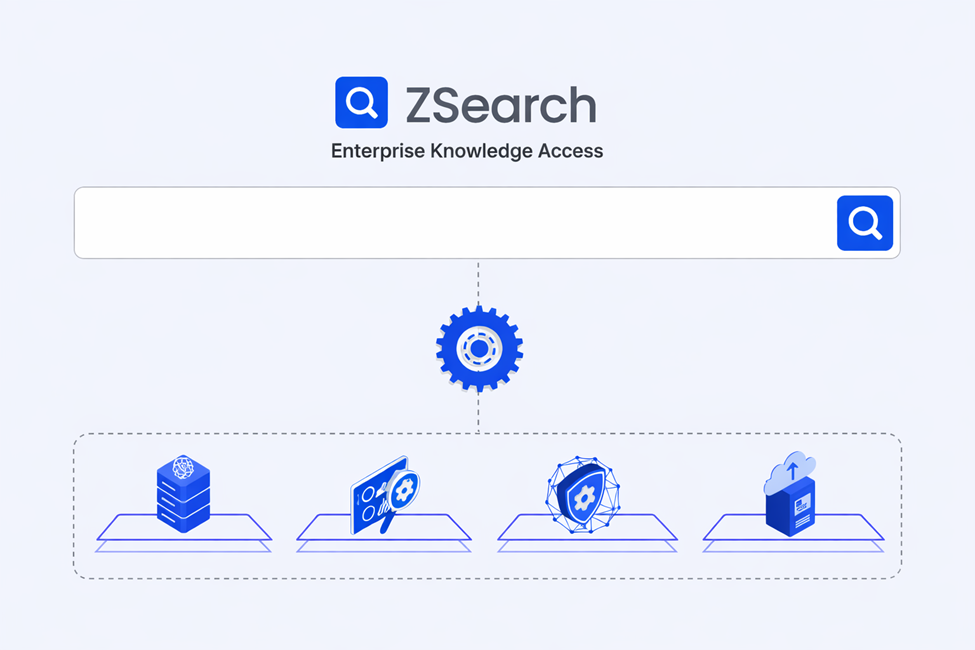
To fully realize the value of a modern knowledge base, organizations are increasingly adopting AI-powered enterprise search solutions. These platforms act as an intelligent layer over existing systems, enabling:
- Hybrid search that combines keyword and semantic understanding
- Context-aware results that match user intent
- Built-in permission controls for secure access
- Project workspaces for collaborative knowledge use
- Seamless integration with enterprise tools
Solutions such as a modern company knowledge base built on AI-driven enterprise search demonstrate how organizations can unify, secure, and operationalize their collective intelligence without disrupting existing systems.
Endnote
For CXOs and enterprise leaders, the message is unequivocal: investing in a modern, AI-driven company knowledge base is no longer optional—it is fundamental to operating efficiently in today’s digital economy. As knowledge management evolves, organizations must move beyond fragmented information and legacy systems toward an intelligent, connected knowledge ecosystem. Those that do so realize measurable gains, including higher productivity, faster employee onboarding, more informed decision-making, and a culture where knowledge is consistently shared and applied.
Implementing an enterprise search solution such as ZSearch often serves as the catalyst for this transformation. By acting as a unifying layer across enterprise knowledge, these solutions ensure that critical information is discoverable by the right people at the right time, without compromising security. The benefits are felt across the organization: teams reduce redundant work, leaders gain visibility into insights that were previously inaccessible, new hires ramp up more quickly, and customers receive faster, more accurate responses because front-line teams have immediate access to trusted information.